A History Of Batman and The Scarecrow, Part 1: Golden to Dark Age Comics
Despite his obsession with fear making him a natural foil to the Dark Knight, Scarecrow stories rarely dig deeper.

Welcome to a three part essay series tracking the evolution of the villainous Scarecrow across Batman media. In this part, we’ll be looking at his earliest appearances in the Batman comics themselves.
The Scarecrow is my favorite Batman villain. As a competing “Master of Fear,” he’s one of the most natural conceptual foils to Batman in Gotham City, neck and neck with The Joker’s colorful sadism, the Riddler’s compulsive need for answers, and Two-Face’s fractured psyche. Scarecrow is a rare villain who can make Batman afraid — but with his fear toxin, and that’s kind of a cheat. Once the toxin or transmitters stop working on Batman, Scarecrow folds as easily as straw.
That’s why my love for his character has always felt rooted more in concept than execution; Batman stories with Scarecrow have often fallen short. As foremost Batman historian The Black Casebook has said: “It’s baffling how few good stories Scarecrow has. You’d think the guy would be a slam dunk.”
Writers fail to conceive of Jonathan Crane beyond his fear toxin weapon, which makes Scarecrow-led stories gimmicky and formulaic. You can see this in even the most acclaimed Batman stories, like Batman: The Animated Series, The Dark Knight trilogy, and Scarecrow's recent and underwhelming appearance on Batman: Caped Crusader Season 2.
Absolute Batman, which recently completed its third arc — The Straw Man — finally made Scarecrow into the terrifying villain he deserves to be. Scott Snyder and Nick Dragotta downplay the fear toxin in favor of more psychological manipulation and orchestrated campaigns of terror and misinformation.
Now, Absolute Batman does strip out any notion of Crane being a teacher; his interest in fear isn’t academic, rather he’s a mercenary who creates campaigns of misinformation by playing on his targets’ fears. He makes Gotham afraid of Batman — an easy enough task with the help of two murder frame-ups — but also almost convinces Bruce Wayne his whole life is a lie. We live in an era of dread, Scarecrow tells Batman, and rather than a gangly scientist studying that fear, this Jonathan Crane is creating it.
How Scarecrow became the villain we know
As with any Marvel/DC character who’s endured via inertia for decades, you can track how Scarecrow gradually reached the version that pop culture/casual fans imagine bit by bit across the decades. That’s exactly what I did upon finishing The Straw Man, looking through Scarecrow’s major comic appearances through the decades and searching for patterns in the threads.
Created by Bill Finger and Sheldon Moldoff, Scarecrow debuted in a story published in 1941’s World’s Finest Comics issue #3. That makes one of the earliest Batman villains of those who became regulars: Slightly younger than the Joker and Catwoman, but beating Two-Face and the Penguin by about a year and the Riddler by seven.
The Riddle of the Human Scarecrow introduces Crane as a psychology professor who loved to frighten birds in childhood, and now studies fear in the human mind.
“Very often an incident in childhood suggests the sort of person that child will be when he has grown up. Such was the case with Jonathan Crane.”
To teach his students the power that fear holds, Crane discusses how gangsters maintain protection rackets through fear. Then, as a demonstration, he fires a gun in his classroom. Crane has few friends among the faculty, who mock him as a “Scarecrow” for his shabby clothes (Crane spends all his money on books). Eager for respect and even more money, Crane recalls his lesson plan, gets himself a Scarecrow costume — “A symbol of poverty and fear combined!” — and begins hiring himself to spread fear to, for example, a businessman who needs a litigative former partner silenced.
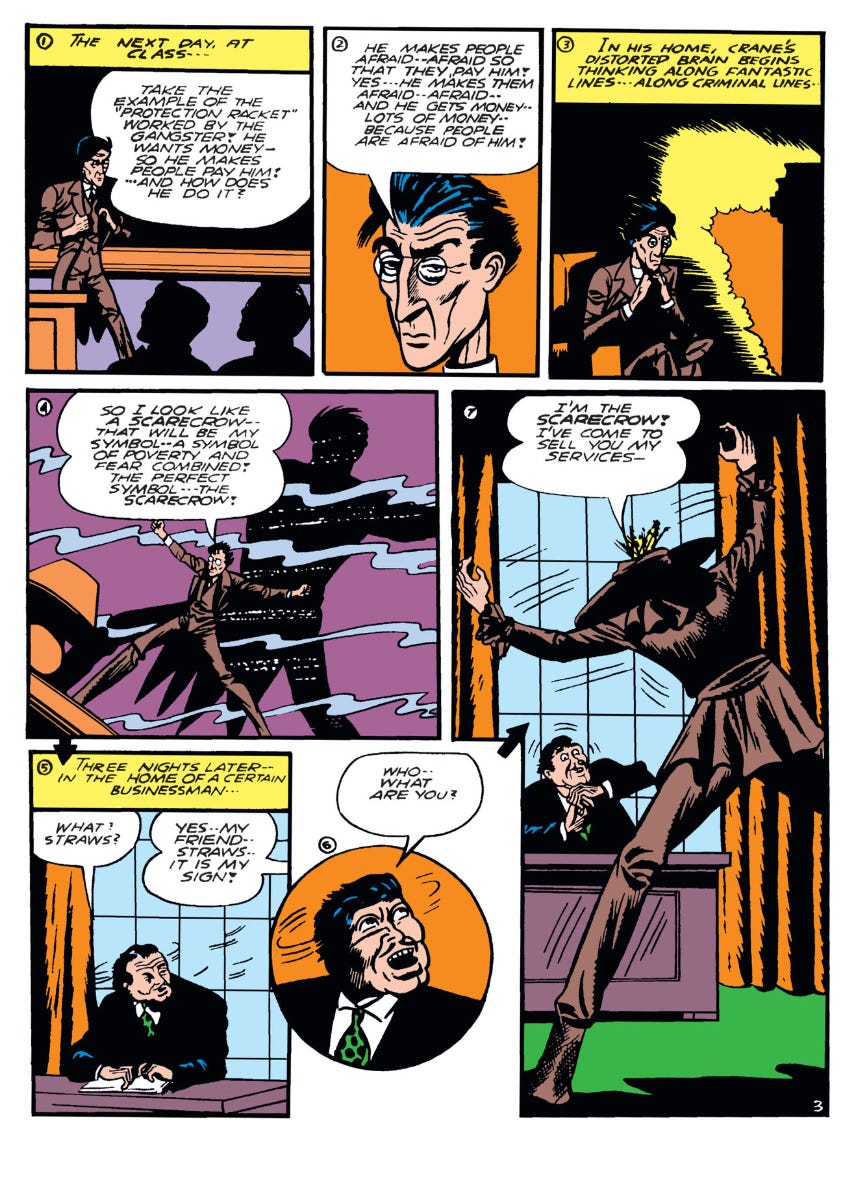
Later iterations of Scarecrow would hew closely to this origin (sometimes retelling it panel for panel). Scarecrow as an extortionist, or someone who uses fear to reap financial gain from his victims, has stuck around as an essential piece of the character. But him as an agent of fear for hire? Not really until Absolute Batman. That might be because of the issue’s own jumps in logic. The Scarecrow’s racket is based around him scaring people who his clients want scared, with Crane — egghead that he is — certainly thinking he can terrify people the best because of his time spent studying fear. But what makes a lithe man prancing around and barking threats of intimidation in a Scarecrow costume during broad daylight scary? In this debut, Scarecrow uses a gun to scare people — what does he need the costume for then? What makes him any different from typical thugs and extortionists. I can see how writer Gardner Fox eventually decided that Crane needed a more theatrical weapon (more on that soon).
World’s Finest Comics #3 blatantly teases the defeated Scarecrow’s return, with Crane stewing behind bars that “those stupid fools actually think they’re going to keep me here.” Sure enough, he was back in Don Cameron and Bob Kane’s Detective Comics #73 in 1943, with a cover that boastfully declares, “By Popular Demand, ‘Return of the Scarecrow.’” In this story, Scarecrow tries to rob a war bonds sale at boxing match (this was written during World War 2). As with last time, a stewing Crane taunts Batman that no prison can hold him — but it’d take 20 years for Scarecrow to return.
In 1967’s Batman #189, Moldoff revived the Scarecrow alongside Gardner Fox. This long delayed third time was the charm, because now Scarecrow used fear-inducing toxins as weapons.
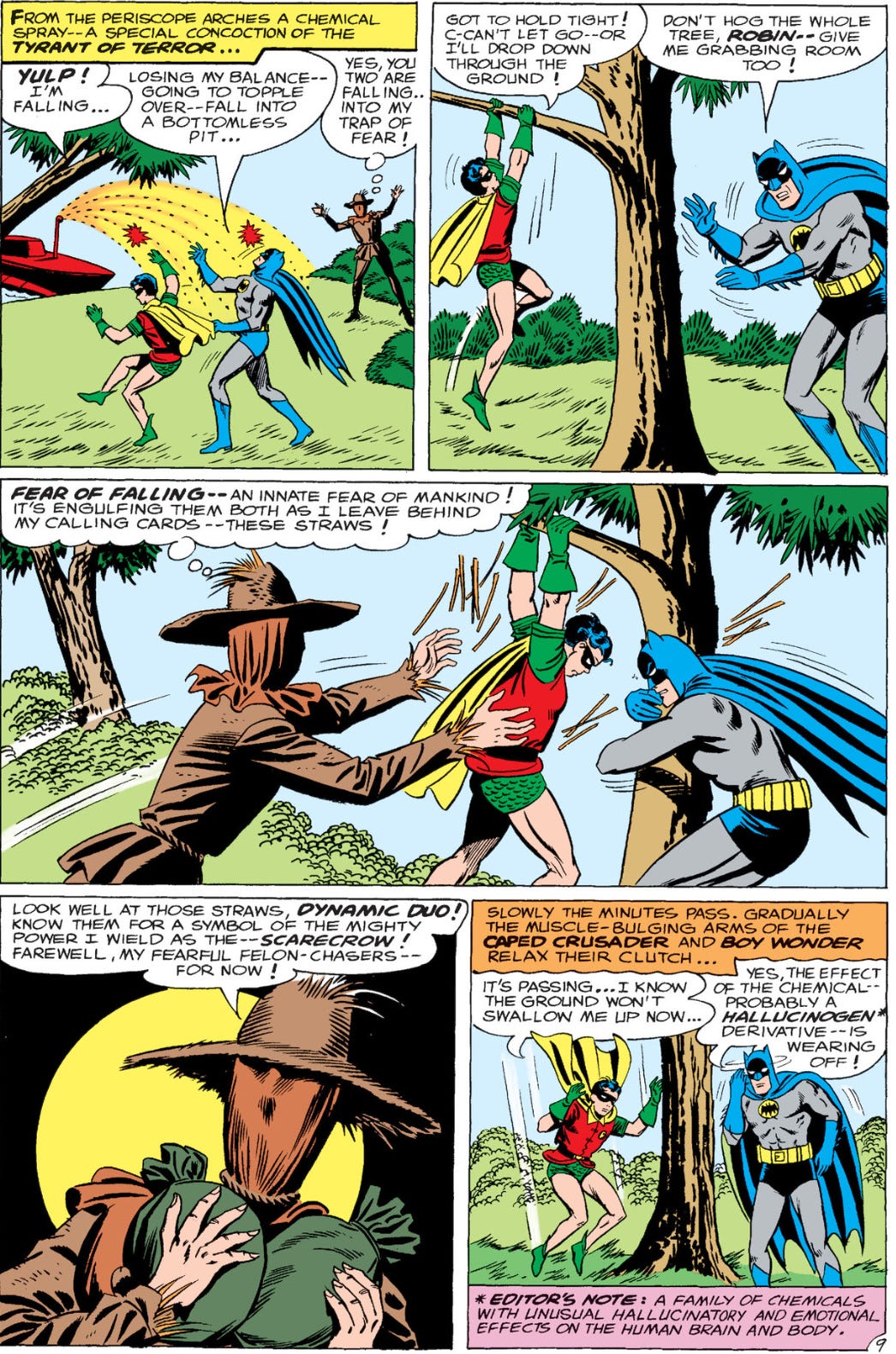
It feels like a move inspired by the contemporary Adam West Batman show, where seemingly every villain had their own trademark gas weapon. But it was ingenious here, for now Scarecrow had a plausible and theatrical weapon for frightening people — Caped Crusaders and Boy Wonders included — to near death. It also finally gave credence to the idea Crane is a unique master of fear, for he concocted the right chemicals to trick people’s brains into seeing their greatest fears. It ties into his academic background elegantly; Crane may have been a psychology professor, but if his study is all on how the human brain experiences fear, why wouldn’t there be a pharmacological side to his research?
With his new gas gimmick (and it not yet being a crutch) and fresh revival in the mid 1960s, it’s surprising Scarecrow didn’t make his way onto the Batman TV show itself. Maybe if its fourth season hadn’t been canceled, we’d have seen special guest villain Peter Cushing as Crane battling Adam West, Burt Ward, and Yvonne Craig’s Dynamic Duo + one. Nonetheless, Scarecrow did get the honor of being the villain of the landmark Batman #200 (by Mike Friedrich and Chic Stone).
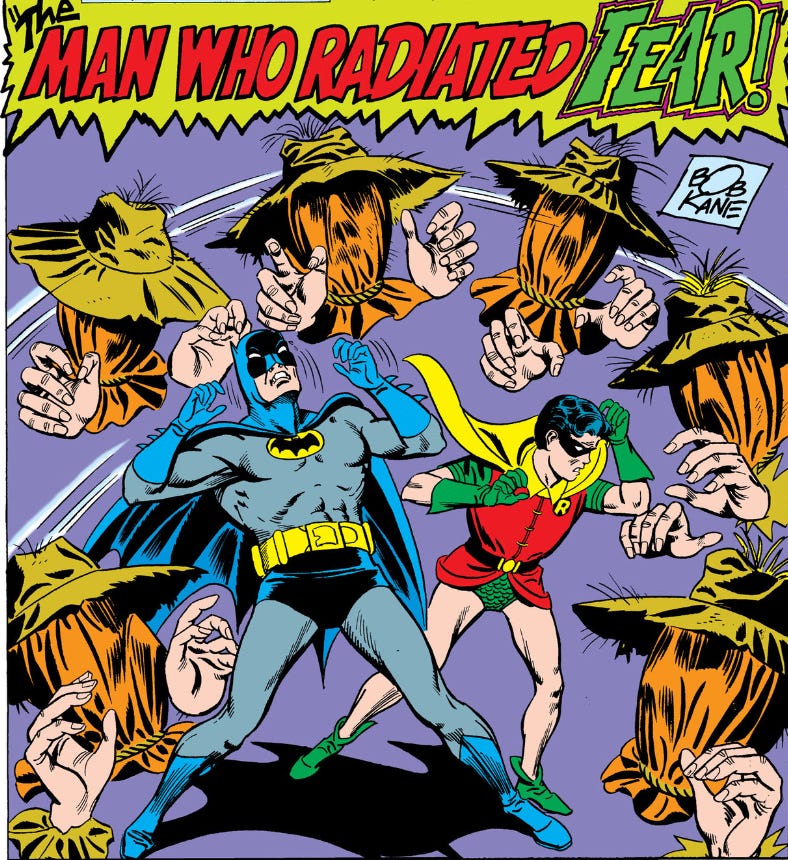
In this story, Scarecrow terrifies Batman and Robin so much they consider stepping away from crimefighting. It functions as a way to explore both of their blood-soaked origins, because Batman and Robin are reminded of the respective vows they made to their own late parents (and also catching up new young readers who may not be aware thereof). Here we see the formula of a typical Scarecrow story taking shape — Crane is a vehicle to pull out Batman’s own fears.
Detective Comics #389, or “Batman’s Evil Eye” (by Frank Robbins and Bob Brown) arrived in 1969, the very beginning of Batman comics going gothic following the TV show’s cancellation. Batman himself muses:
“We’ve sure come a long way from the days when my very appearance as that feared creature of the night — the bat — used to strike terror into the hearts of men with guilty consciences—the night creatures of the underworld.”
But those days are back; the Scarecrow poisons Batman with a toxin that makes him inspire fear in anyone who sees him. (At the comic’s climax, Scarecrow traps Batman in a cage with mirror glass on all sides.) Here is the first textual acknowledgement of how both Batman and Scarecrow use fear as a weapon, something that definitely would not have been possible in the Adam West era of Batman.
One of the bigger disappointments is 1975’s Batman #262, “The Scarecrow’s Trail of Fear!”, by the legend Denny O’Neil and Ernie Chan. It’s mostly a carnival setpiece, with Scarecrow’s presence feeling incidental; he gets a particularly pathetic defeat here, crumbling before Batman in fear himself (which will soon become another Scarecrow story cliche). O’Neil revived the Joker and Two-Face, introduced Ra’s al Ghul, and *this* is the best he could do for Scarecrow?
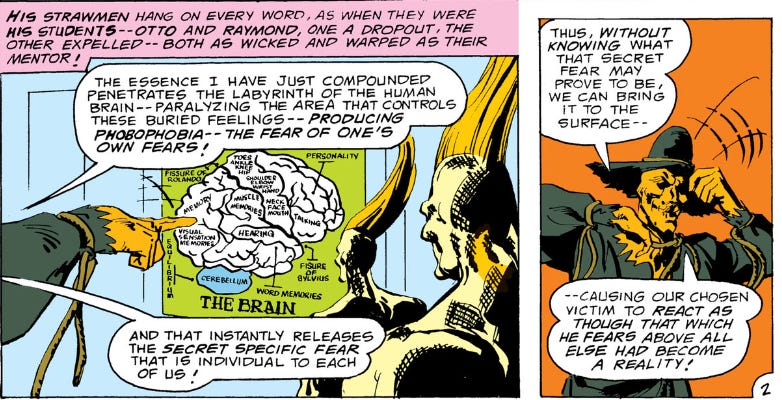
Batman #296 by David Vern Reed and Sal Amendola makes the fear toxin, introducing the idea Crane has tweaked it to target and create the victim’s specific phobias rather than generalized panic. (Batman’s fear? “Losing [his] capacity to carry on [his] work.”) The issue frames Scarecrow’s exposition dump like a teaching lecture to his henchmen, a nice touch of consistency — as is that his primary goal of sowing fear is reaping profit.
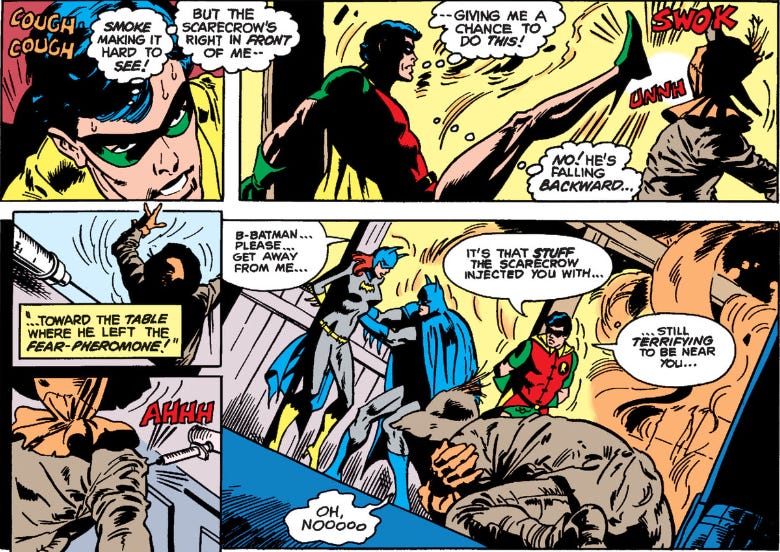
Gerry Conway and Don Newton’s “Six Days of the Scarecrow” in Detective Comics #503 is a loose remake of “Batman’s Evil Eye,” as the Scarecrow once more drugs Batman with something to make others — including Robin and Batgirl — afraid of the Dark Knight. We get a hint of what draws Crane to fear when he muses “power over another human being is a very intimate thing,” a musing which makes the “Scarecrow dosed with his own fear toxin” ending here extra karmic.
Reading these comics, I noticed that despite Scarecrow’s whole theme being fear, they never push into true horror, or even horror adjacent, storytelling. The terror when Scarecrow enters the scene is anything but palpable. Scarecrow feels like just another of Gotham’s gimmick villains. The first comic I read on this deep dive that did start pushing further was a two-parter (or at least part one of it) — Doug Moench and Gene Colan’s Batman #373/Detective Comics #540. The #373 cover alone, with Scarecrow standing triumphant over Batman broken across a gravestone — with a freshly dug grave nearby, and Robin hiding behind a tree that looks like it belongs in a haunted forest — is the scariest that Crane had ever looked before.
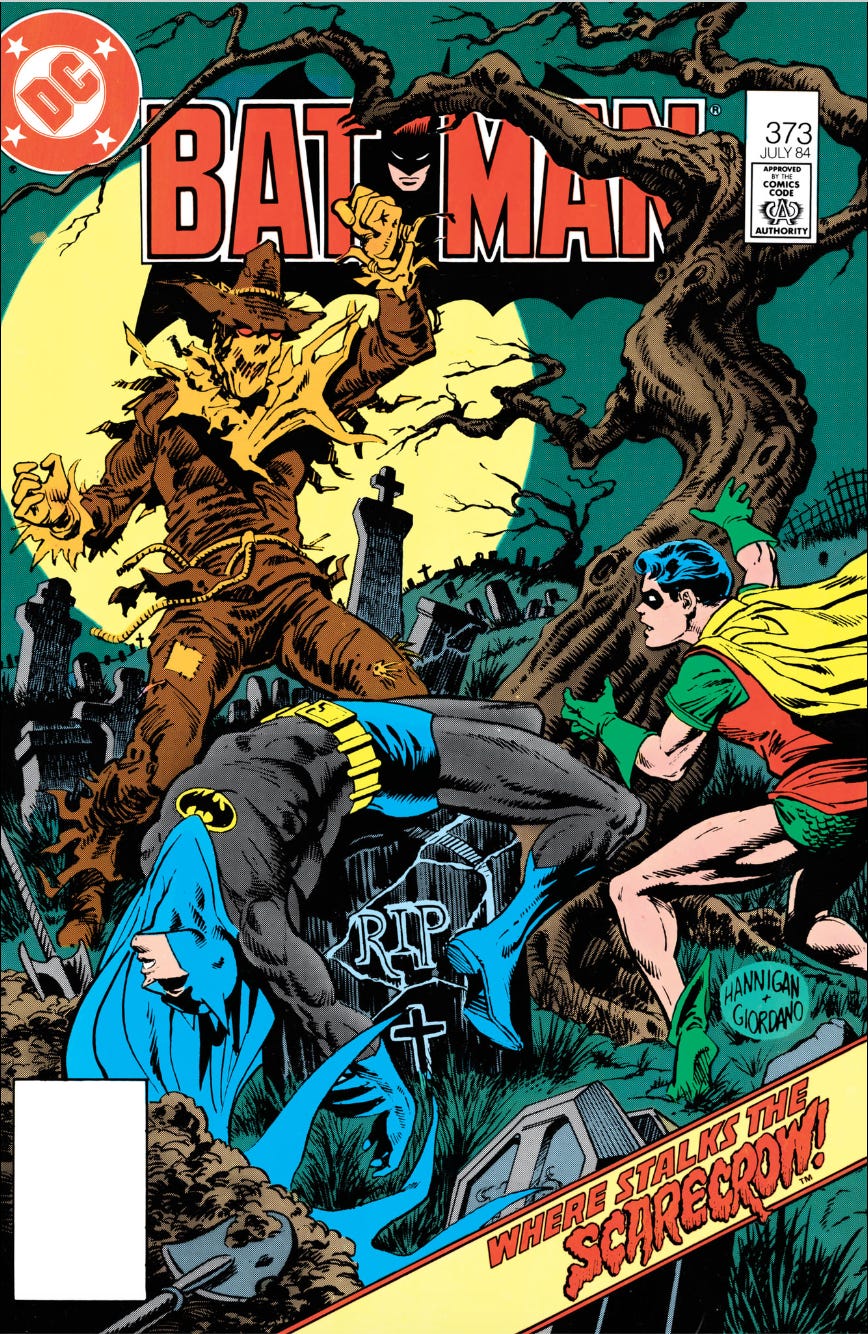
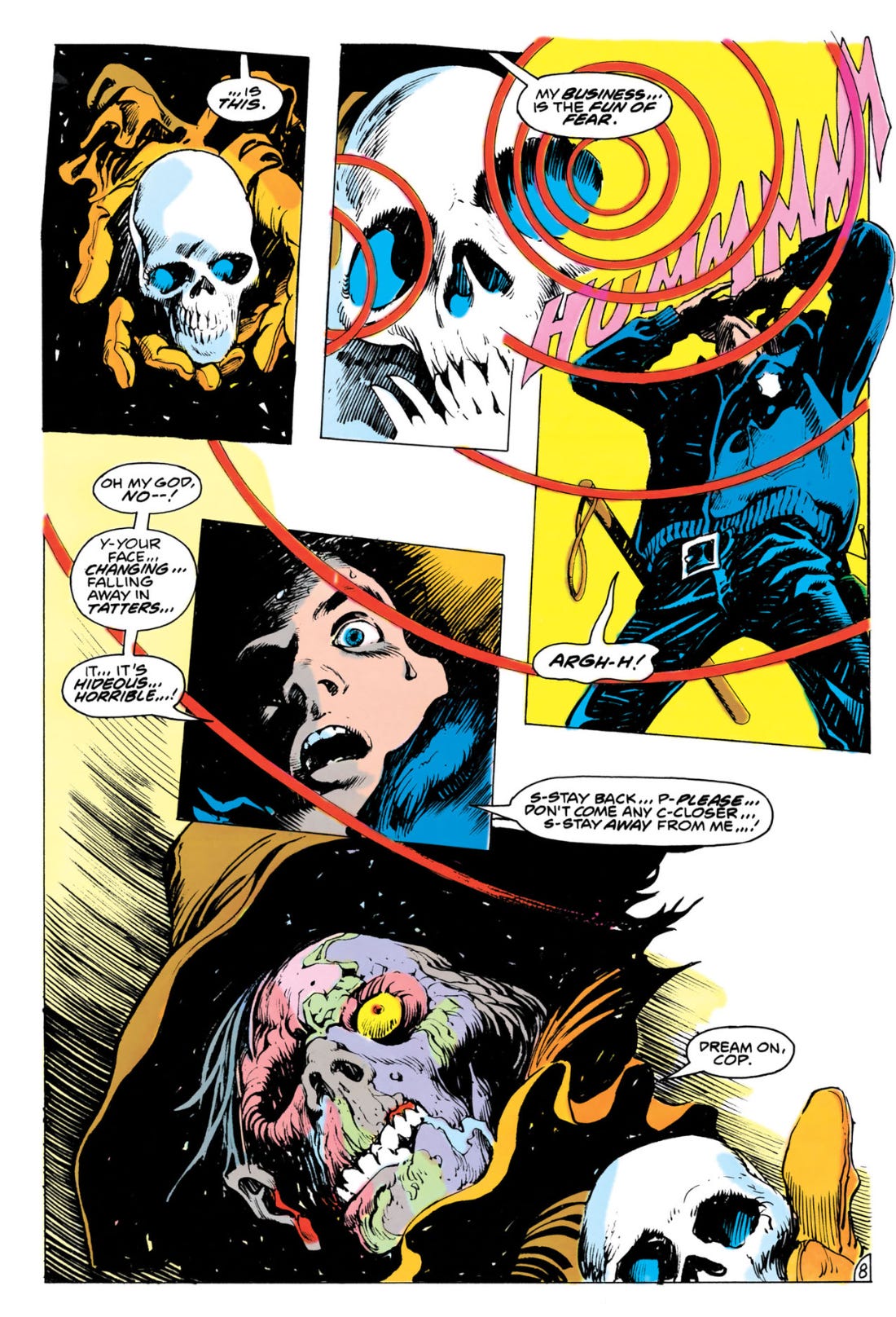
In this case, you can judge this book by its cover. Scarecrow switches from gas to a transmitter device that sends fear-inducing signals into the brain. Shaped like a skull, it’s a morbid touch (even if it does make his mastery over fear more artificial than ever before). The stand-out sequence is when Scarecrow debuts the fear transmitter on a hapless cop; we see Crane through the cop’s eyes and his visage is horrific and zombie-like. The panels tilt just slightly out of place, as if the transmitter’s waves are shaking the cop’s very world. Finally, a comic that wants the reader to understand why Gothamites would cower in fear when faced with Scarecrow — and hopefully make those readers cower themselves too.
Scarecrow would not have to wait long after DC’s Crisis on Infinite Earths to return. Enter Mike W. Barr and Alan Davis’ “Fear for $ale”, or Detective Comics #571. Along with another retelling of Crane’s origin (this time drawn by Davis, with little changed from the original despite the continuity reboot), we follow Scarecrow’s latest scheme: a concoction that removes your fear, and then extorting every person in Gotham with new suicidal confidence in exchange for the antidote. It’s such a simple but intuitive flip on Scarecrow’s gimmick, and comes packaged with the pat moral lesson on how a little fear is good, that it’s little surprise a cartoon would later adapt it. But Scarecrow himself, skinnier and spindlier than ever to the point it looks like he could bend his limbs with the ease of hay, is little more than a gleeful and cackling bad guy here — puns and evil laughs included.
Batman Annual #19, Doug Moench and Bret Blevins, published in 1995, reimagines Batman and Scarecrow’s first encounter while stretching back further into Crane’s past. Bullied as a child and finding solace in books, this Crane was a serial killer — and the Scarecrow — long before he met Batman. On his high school prom night, he dressed as a Scarecrow to frighten his bully, Bo Griggs, and Griggs’ girlfriend, Sherry Squires, into a fatal car crash. He then murdered a Gotham University professor to secure his own place at the university.
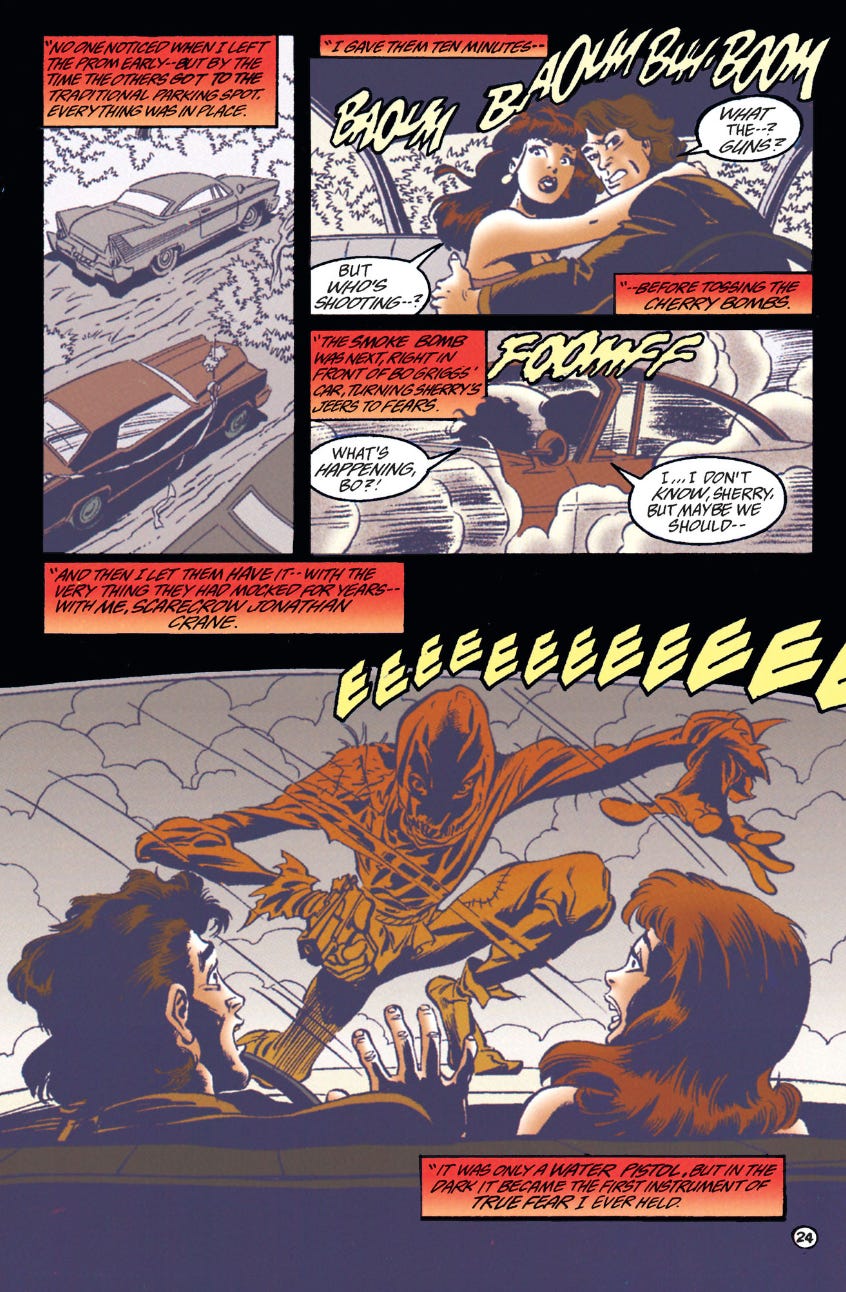
Moench draws parallels to Crane and the other famous Scarecrows of pop culture through a young Jonathan’s reading habits. Calling The Wizard of Oz the “last comfort reading” he ever did, he declares “I was different from [Frank Baum’s] Scarecrow because I did have a brain” while hatching his revenge. Crane also compares his life story to his namesake Ichabod Crane in The Legend of Sleepy Hollow. Ichabod Crane was run out of town by a bully wearing a disguise, and Jonathan Crane co-opts that idea because he refuses to let the world scare him.
The story is titled “Scarecrow - Masters of Fear,” the plural word lumping Batman and Scarecrow together. The comic opens with Batman, still a rookie, musing how fear is the greatest tool he has and tempting fate. When Batman gets his first taste of Scarecrow’s fear toxin, he remembers his parents’ murder. Conversely, when Batman finally confronts the Scarecrow and the villain asks what he is, Batman replies “Fear itself.”
The comic not only expands on why Crane became the Scarecrow but streamlines the original story of World’s Finest Comics #3 to account for later Scarecrow characterization. For one, Scarecrow wins contracts by demonstrating his fear toxin’s effects on his clients, turning his terror racket into a double-ended extortion. In this telling, Crane only dons his Scarecrow persona again after being fired to murder the university board that dismissed him, taking cues from the Scarecrow in the contemporary Batman: The Animated Series.
To be continued in Part 2, which will examine Scarecrow’s appearances in Batman animation and what those stories have added to his characterization and aesthetics.
I recently read the 1983 graphic novel “Fear” in which Captain America and Ghost Rider team up against the serial killing Scarecrow (it's excellent)!
This was terrific!
If you were so inclined, you could compare and contrast DC’s Scarecrow to Marvel’s (IIRC 3 different) Scarecrows.