Corpse Knight Review: This Wizard Of Oz Riff Needed A Longer Yellow Brick Road
Unlike its undead hero, Michael Chaves’ Corpse Knight could use a little room to breathe.

Dark fantasy that blurs the lines of historical fiction and horror is a genre mashup of which I can’t get enough. New Image Comics/Skybound series Corpse Knight offers just that blend, and it left me wanting even more.
Earlier this year, for /Film, I corresponded with filmmaker and Corpse Knight writer Michael Chaves on the eve of the series’ often stunning first issue printing. Now that the concluded series is being released as a collected volume, I wanted to check back in on this comic. I kept up with it monthly and don’t regret doing so.
In 1429 France, little girl Foy loses her Papa when he dies protecting her from bandits, leaving her an orphan. Inspired by Papa’s story of Joan of Arc resurrecting a baby with a godly touch, Foy prays over her father’s grave for his return. One night, when brigands come to hurt her, her father crawls out of his grave and defeats them — but aside from his instinct to protect his daughter, this Corpse Knight is not the man he was. For one, he still looks dead when unmasked.
An easy comparison is Frankenstein. (For /Film, Chaves told me that every story about a reanimated corpse “owes a debt” to that one, including his). Only in this, it’s a child reviving their parent instead of Victor Frankenstein, in arrogance and grief over his mother’s death, making a child for whom he can’t accept responsibility. Note, even, that lightning strikes timed with Foy’s prayer and her father rising again, like the burst of lightning that animated Boris Karloff’s Creature in the James Whale Frankenstein.
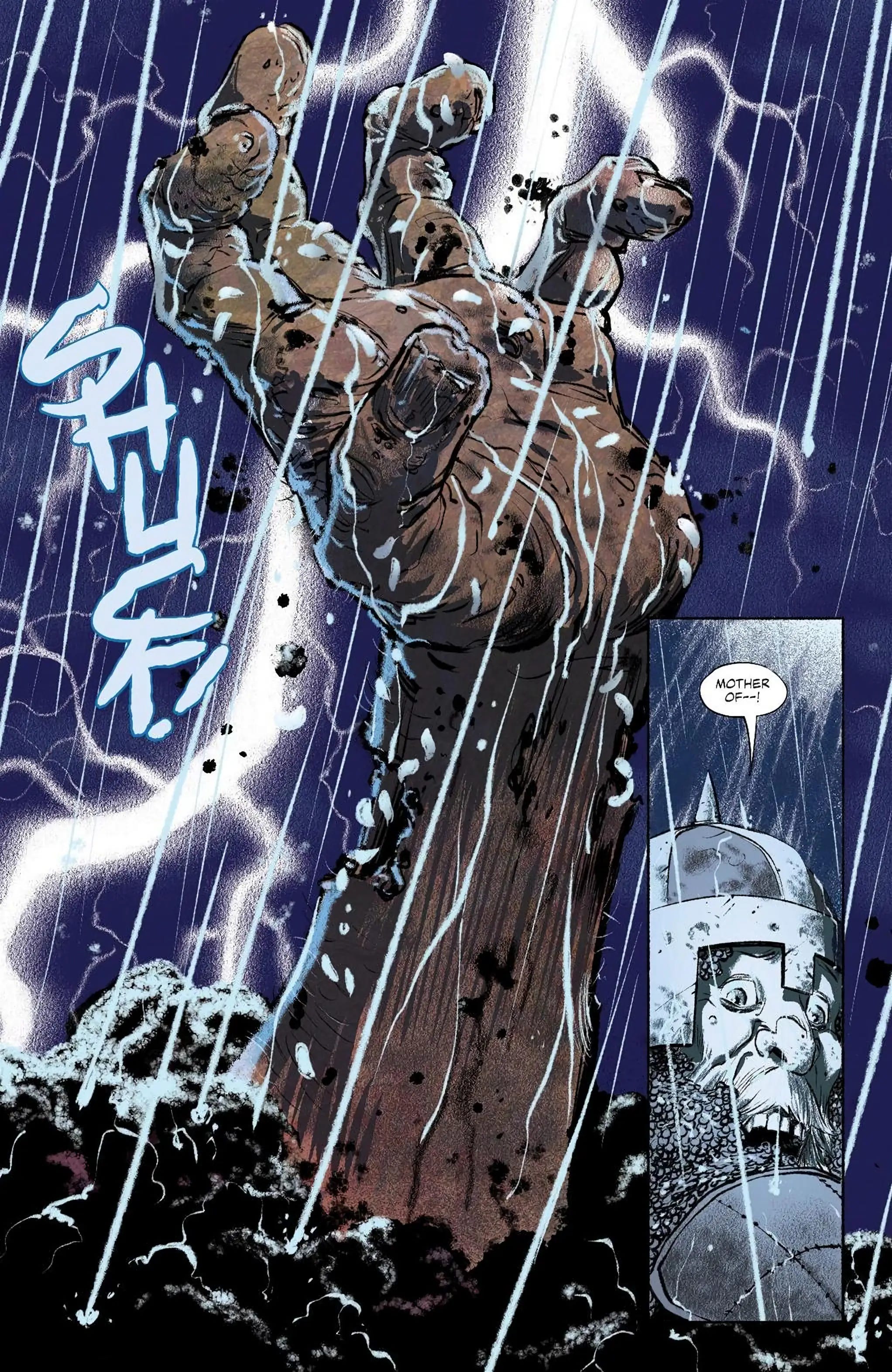
That’s far from the only homage I saw in Corpse Knight. Take note of how Papa dies, shot with multiple arrows in his back protecting someone smaller than him, or a sacrifice staged much like Boromir’s in The Lord of the Rings.
"The mightiest man may be slain by one arrow... and Boromir was pierced by many."
The mixing of Frankenstein with epic dark fantasy also called to my mind a book I adored, M.R. Carey’s Once Was Willem. Set in medieval England, it begins as Frankenstein by way of fantasy; a couple pay a wizard to revive their dead son, Willem, but only a misshapen revenant comes back to them. Corpse Knight hews even closer to Christopher Bulheim’s Between Two Fires. The comic shares that book’s same basic premise: A knight guarding a little girl as they travel through medieval France, even if Between Two Fires is set about a century earlier, in the depths of the Black Plague. And of course, I don’t think any comic about a traveling swordsman in a dark fantasy Europe (or Europe-adjacent land) can avoid comparison to Berserk. There, Corpse Knight is no exception.
A comparison that Michael Chaves made was The Wizard of Oz, because at the end of issue #1, Foy and her undead Papa set out to find Joan of Arc. Foy hopes Joan can restore her father to his true self. That set-up promises an odyssey and there’s no shortage of danger in 1429 France. The Hundred Years War is still ongoing and there should be no shortage of other threats: plagues, wolves, raiders, witches, etc. There’s also the Corpse Knight himself; he can’t talk and, if he removes his mask, people will see a walking dead man or presume him a plague victim.
But instead of that long journey, Corpse Knight is a breezy read. They reach Joan in issue #4, and while there are still twists to be had after that, it’s still a quick journey. Issue #5 reveals Foy’s father was, in life, a witch hunter who fell for her predeceased mother, a witch herself. That deserves its own dedicated issue, not just a brief flashback inside another. Issues #2 (featuring a walk through the haunted Forest of Rambouillet and the first appearance of the book’s true villain, a masked child killer) and #3 (the Corpse Knight struggles to find a healer for a poisoned Foy before they convalesce at a nunnery) especially feel like they could’ve sustained multiple issues.
Now, Corpse Knight had a terminal endpoint built into its premise: Foy and her papa must find Joan of Arc. It couldn’t be an indefinite ongoing, but I think this journey could have sustained, say, 24 issues, or at least 12. But Chaves has a filmmaking career to think of — and no matter what he says, it’s hard to not read Corpse Knight as proof of concept for him to make it a movie that can fill in the details the comic left unpainted. As he told me at /Film, a story as dark and strange as this needs IP backing for a studio to bite. Now, he and Skybound have delivered them the IP.
I’ll defer to Chaves’ own statement in the Corpse Knight #4 letters page:
“My original goal was to make something that would be nearly impossible to make as a movie - a period epic with a kid as the lead is basically a non-starter movie idea in today’s film business. I think I was partly inspired by something Brian K. Vaughan said about writing Saga that he wanted to make something intentionally unadaptable...I always loved that confidence but also just the idea that this might be the only place you could read this kind of story. But having said all that, maybe I should give HBO a call...”
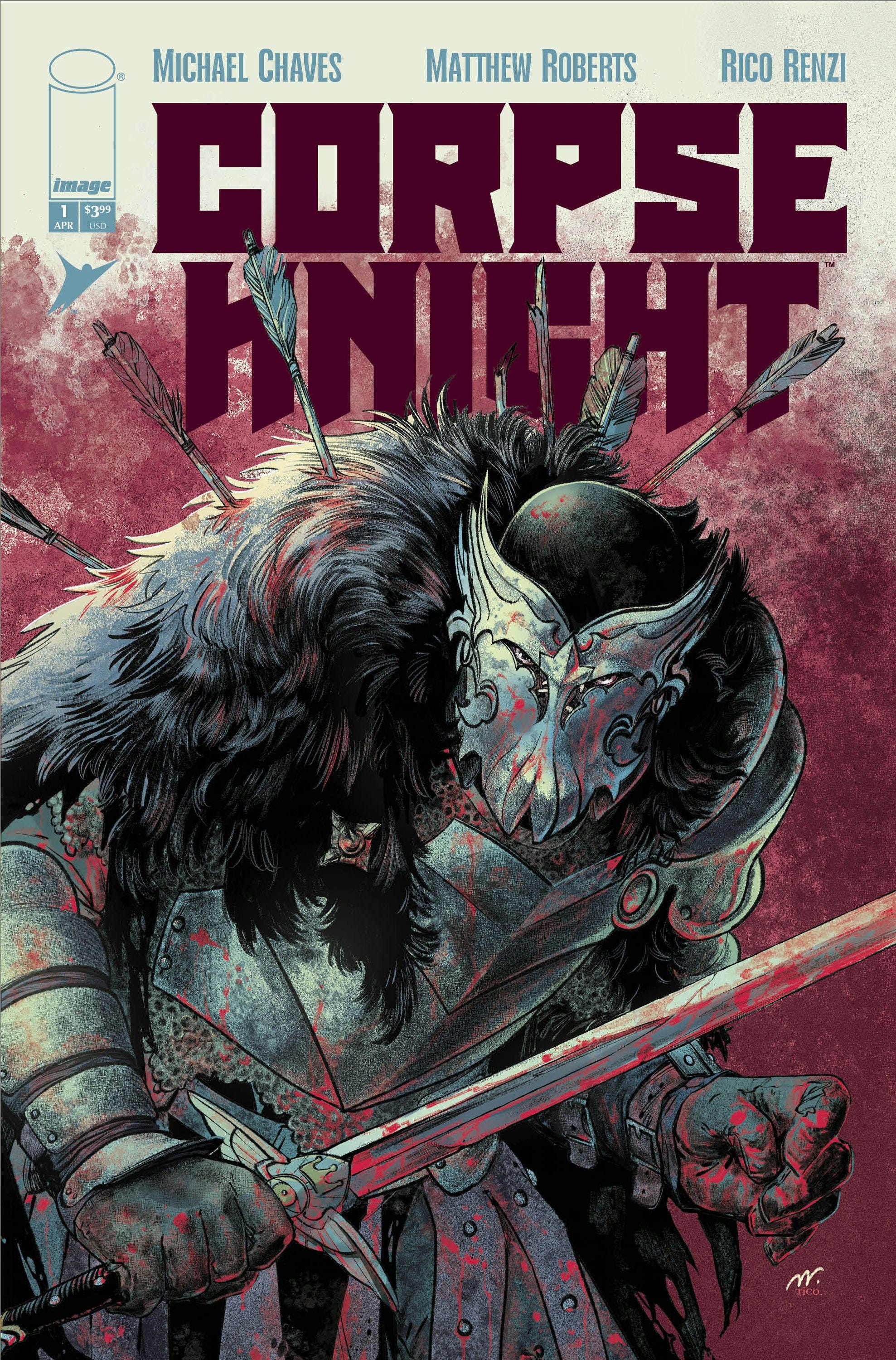
In his Corpse Knight forewords and in interviews, Chaves graciously credits his art team — penciler Matthew Roberts and colorist Rico Renzi — for helping him learn the craft of comics. That praise is well-earned; I’m not sure Corpse Knight could only be told as a comic, but it looks beautiful in its chosen medium. Roberts’s character designs sing, particularly the titular character that has to look scary but cool and imposing.
Take the distinctive mask, which has a v-shaped helm with horn-like curves. Or the fur-pelted shoulder guards and tattered purple cape. On the silhouette test of comics character design, the Corpse Knight definitely passes. Roberts’ cover for Corpse Knight #1 shows off the knight, holding a bloody sword, with the arrows that first killed him in his back and placed against a red bleed background. You know a comic character design is a winner when a cover can rest on it like that.
The Corpse Knight’s design echoes how Roberts draws the settings and landscape. The comic pushes the edge of historical fiction just enough. It doesn’t look completely divorced from reality, even with undead knight and haunted forests. So, it earns the feeling this could have actually occurred in medieval France. Renzi’s colors are often bright and lurid (like a purple night sky or slimy greens during the forest scene in issue #2, see below). In historical fantasy, many artists fall back on dreary grey coloring, but Corpse Knight is more vibrant for its color scheme.
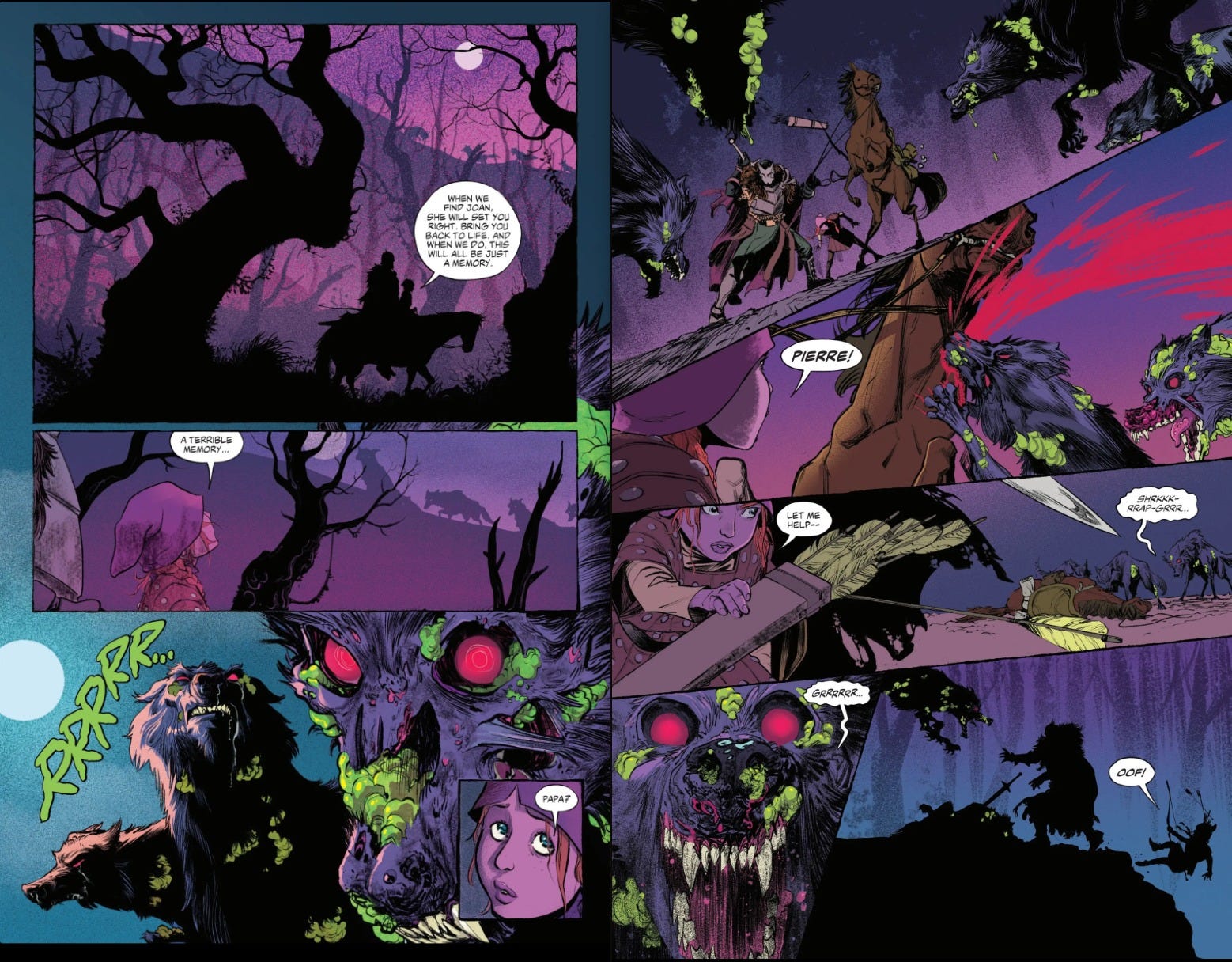
Look again at those two pages from Corpse Knight #2 and notice how quickly they move. On the previous page, Foy and her father had not even entered the forest yet. Then, the page only gives its top half room to set the mood before the wolves attack. The following page then uses three wide and thin rectangular panels to show only big picture beats, dividing the fourth strip into two for a close-up of a growling wolf and Foy tumbling. That’s a lot for two pages, when we haven’t even gotten to know the setting yet.
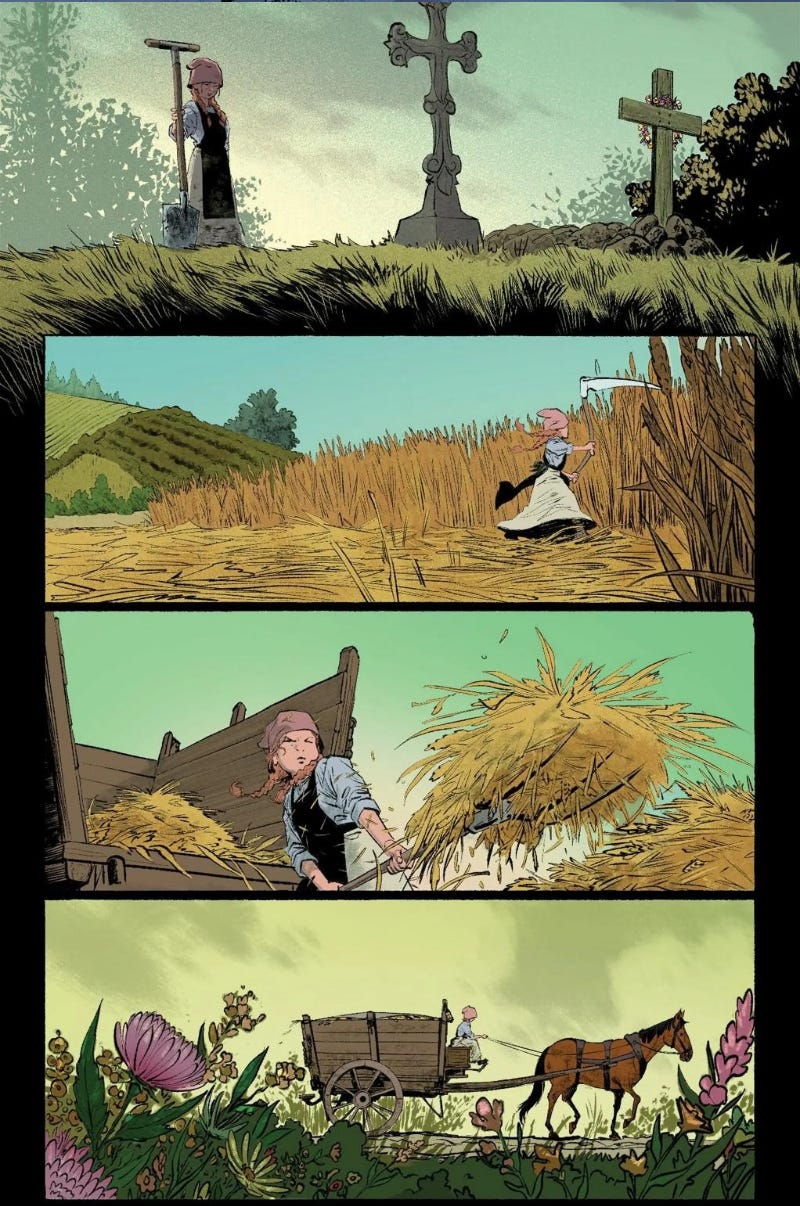
The first issue uses a similar page structure for a wide time jump. After burying her father, we see Foy going to work as a farmer, alone, for two panels before the transition panel of her riding back into town.
Sometimes, like the pivotal two pages in issue #5 (see below), Chaves and Roberts don’t even use panels to compress time but multi-scene, time-defying layouts resembling multiple-exposed photographs.
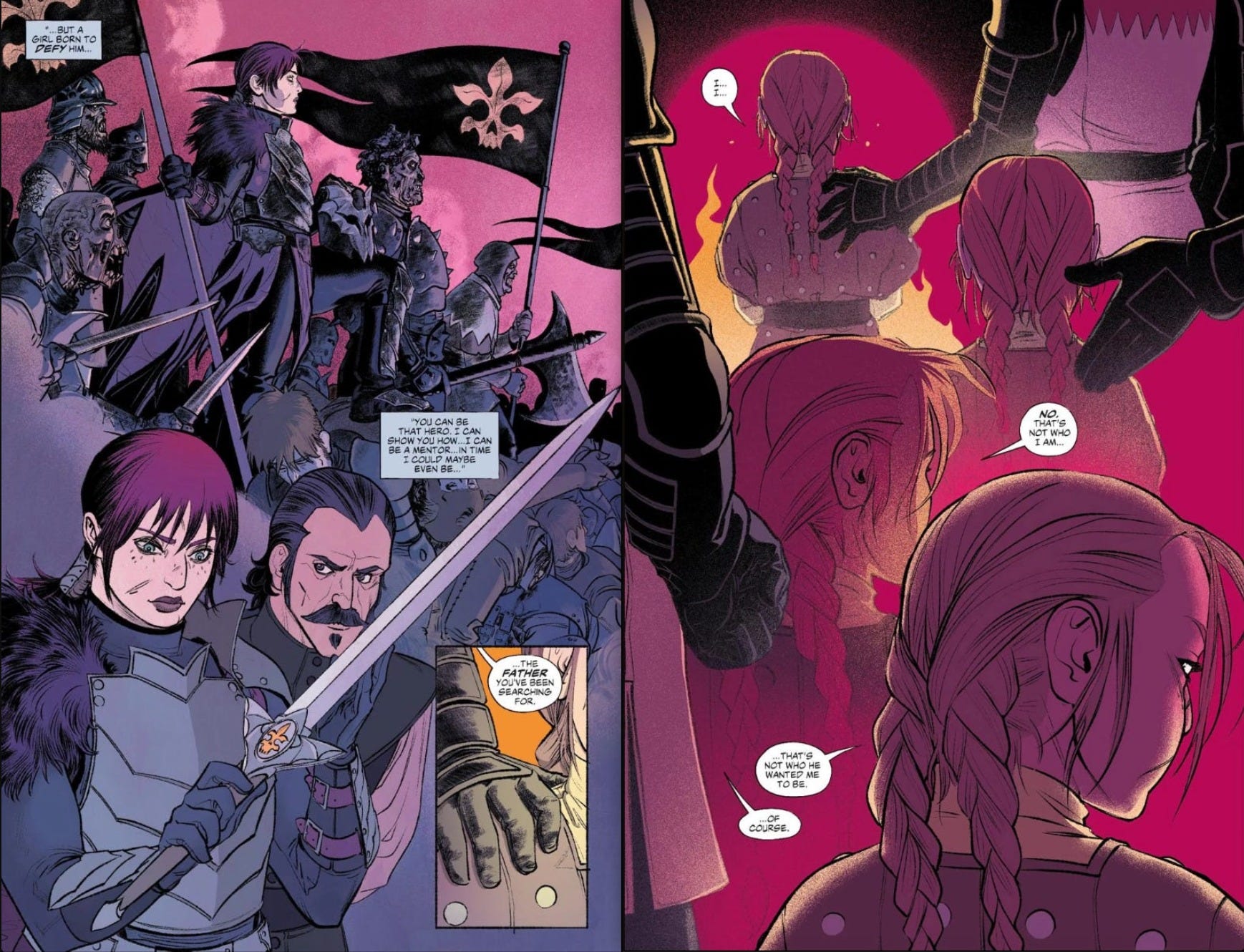
Referring back to my /Film interview with Chaves once more, he noted part of the learning curve coming from film to comics was:
“In comics, every single panel has to carry that weight on its own. You’re asking the reader to feel motion and time without actually showing it. So you have to be incredibly thoughtful and economical. Every page, every panel matters. It’s like writing a haiku.”
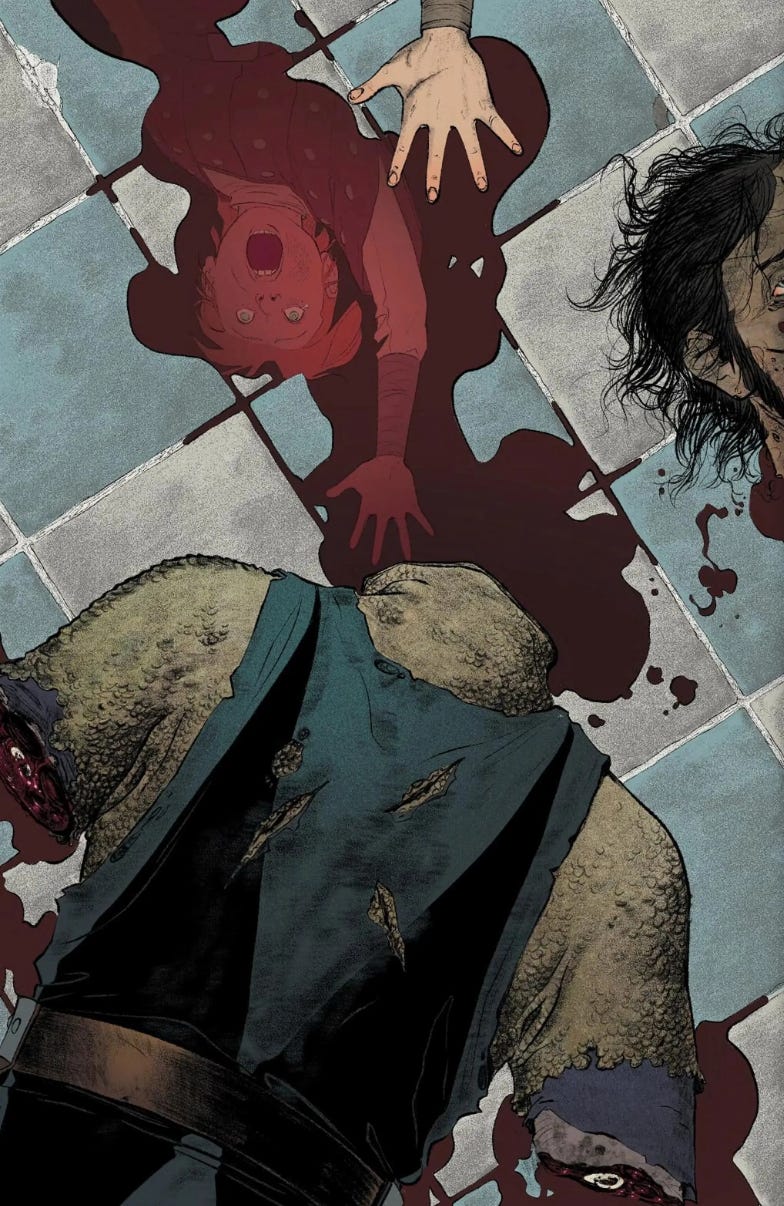
I think these pages that jump through time with big moments show an artist in the process of mastering those principles Chaves outlined. Even so, many of the vital panels in Corpse Knight do their intended job and carry that weight. The greatest has to be the final page of issue #4, when the knight’s head sits sliced from his body and Foy’s reflection can be seen in the pool of blood between the severed pieces.
I wouldn’t be surprised to, some time in the near future after Michael Chaves is done making his current movie Yeti, come across a Hollywood Reporter headline that he’s now going to self-adapt Corpse Knight into a movie. I will watch that movie if/when it happens, but reading the comic made me wish for one thing even more: a version of this comic that got to be four times as long and live more deeply in its world.
Rating: 7/10.
Discussion about this post